Much has been written and discussed since November 4, 2008 in the attempt to sort out why our efforts in California against Proposition 8 failed to actually beat the proposition. We should of course study hard and learn from mistakes, and above all move forward with this momentum. But what continues to impress me the most is the collective spirit of giving — of all of your stories — that has taken place as a result of this profound effort. I devoted myself for an all-too-short time to the No On Prop 8 campaign (big thanks to my friend Calla Devlin for that opportunity), and for the record, I am honored to have been a part of it. I believe it has forever changed me in ways I’m not even fully aware of yet. Every one of you who played a part in sharing your stories during the campaign — you have affected me deeply. And you still do.
No On Prop 8 on Facebook
Anthony shared how he was a “recovered homophobe” — and how he overcame it. Eric twittered about being alone with a sign down in Los Angeles. A Mormon woman from California reached out, against the formal advice of her community, to say I cannot in mercy vote to destroy the legal protections they now enjoy. Entire families worked on the hard conversations, overcame fear, attended weddings, and wrote about it to others. People sold out the signs and rallied by the thousands. People of any persuasion stepped up for the right thing, to vote no on Prop 8. Steven, a straight man from Utah, stood by us faithfully in support. And every day, Abby sent us a personal dose of encouragement and cheer via Twitter. Those are just a few stories, off the top of my head, and are all YOU. T’was the season of personal giving — and it still is.
No On Prop 8 on Twitter
You continue to share your stories in person, on the streets thanks to Join the Impact, and on various social networks: over 172,000 of you on Facebook, 3,200 of you on Twitter, 4,500 on MySpace, and 300 on LinkedIn — which is not to mention the tens of thousands of views on a YouTube channel that rivaled Obama’s in popularity in the days leading up to the election (with — in a first for any political campaign in this country — YOU submitting stories for the official channel) – and the countless blogs and blog comments. I salute YOU.
It is with that spirit that I’m impressed with the organizations involved in the campaign that are striving to bridge the gap between traditional and new media, with the ultimate goal of giving us all a place to be. Check out this page published by the NCLR yesterday:
No longer is it an official press release vs. a blog: it’s just you telling your story. Molly Tafoya recently shared this insight with me: the gift is not to tell people how to feel, but to help people talk about it. To help people share their stories: dare I say that this is the entire point?
Just at this moment @Pistachio comes in, as she is wont to do, with just the right lyric at just the right moment:
“I’m not being radical when I kiss you. I don’t love you to make a point. It’s the hollow of my heart that cries when I miss you.”
“Love is stronger than any words anyway” (Catie Curtis). Find a channel — any channel — but find a channel and, with your words, your pictures, your videos — share about who you are. Because in the end, the most radical thing to do is just to be — who you are.
On the day before the 30th anniversary of Harvey Milk’s death, I can’t say it a better way than this:
“There’s hope for a better tomorrow… And you, and you, and you have got to give them hope.”
You could say that last week’s Web 2.0 Summit lived handily up to its theme “Web Meets World.” You could also say that although I was present in the audience, never more than five rows back from the stage, I was in a major post-election daze throughout and, well, missed some things. Undeniably through this watery filter, as I sit this week and try to wrap up my thoughts on the event, what’s clearly in focus is that what the Web really met last week at the Summit was Politics. I might even try to tell you that’s the only thing — and the most important thing — it met.
Would you blame me? The day after Obama was elected President of the United States, the top-three trending topics on Twitter (say that three-times-fast!) were, in this order: Prop 8, web2summit, and Obama — and they stayed that way throughout nearly the entire conference.
What follows is my wrap, therefore, of the Web 2.0 Summit 2008: Web Meets Politics.
Intro: Web meets world
Fifteen years after television’s birth, the contours of the new medium were just emerging. The idea that this revolutionary new phenomenon — one busily reshaping the very fabric of society — might one day become just another application on a vast web of computers, well that idea wasn’t exactly in vogue …
So begins O’Reilly’s Web 2.0 Summit site on the overall conference theme. “Web meets world” to me means that even things you don’t think have anything to do with the Web have to do with the Web. From the “Transforming the Network to an Enterprise for the Warfighter” session delivered by fatigues-clad LTG Jeff Sorenson, to disaster-management tactics from Jesse Robbins — “many kinds of disasters mean many kinds of opportunities” — to disease and global warming and financial catastrophes and other “Really Big Problems” — the resounding question levied by “meeting the world” was an implied “can we fix it?” to which Tim O’Reilly, in the opening conference salvo, invoked Obama with the “Yes we can” as the collective Web 2 response. From the outset, politics set the stage.
Web meets the president
Arianna Huffington
“Were it not for the Internet, Obama would not have been elected President,” said Arianna Huffington in Friday’s great panel, The Web and Politics (with John Heilemann, Arianna Huffington, Gavin Newsom, and Joe Trippi). “It wasn’t the age of the candidate that mattered in this election,” she continued, “It was the age of the ideas.”
Throughout the conference there was a lot of talk about how well Obama used online channels (most specifically Facebook) while campaigning (it was during this week that he also launched change.gov). Earlier in the Summit, Mark Zuckerberg had mentioned the tremendous success of Facebook Causes in particular during the election — growing “hundreds of thousands of people a day.” Gavin Newsom added that he was “proud to say I have more Facebook friends than any other politician outside of presidential candidates.” Clearly a sea-change has washed upon the country.
“Just as in the 60’s,” people compared, “a new medium became the dominant medium in this election.” Whereas TV was the “new” one-way broadcast medium when JFK used it so adeptly during his debate with Nixon, the Internet brings interactivity, dialog, and conversation to the mix, and voila: as Huffington said, “the truth intrudes into people’s living rooms.”
Web meets (dirty) politics
But there’s a flipside to the truth coming into our living rooms.
While acknowledging the sea-change, Newsom pondered, “how does this manifest itself in terms of shaping public policy?” I was glad to hear Newsom mention the need to address the “digital divide, saying that though Web 2.0 is meaningful, it’s “utterly meaningless to those who need this type of influence and engagement the most” – to those who aren’t online.
Then he indirectly referred to California’s Prop 8 when he mentioned he had his own “Howard Dean” moment broadcast all over YouTube (the “whether you like it or not” ad from the Yes campaign). He said, “The YouTube-ification of the world – I’m desperate to get it to go away and I can’t get it to go away.” Regarding the “always-on” internet-effect, tweeters wildly twittered his sound-bite “Authenticity – we’re all for it unless it’s the kind of authenticity we don’t like,” and he wondered “Are we more or less authentic if we’re always on the record?” Trippi replied that “No one can fake it 24 hours a day.”
I liked that Newsom’s bottom-line was that we should embrace it — and become more forgiving of mistakes — but thinks there will be a lot of collateral damage.
Speaking of collateral damage, at 44:10 in the above video, commencing the Q&A period, I got up shakingly and raised following, coming directly from my experience on the No On Prop 8 campaign (and here I quote myself self-consciously):
We’ve just experienced the terrible flipside of “truth into our living rooms,” which is that the Internet can also be used, with devastating effectiveness, to spread attacks and lies into our living rooms. Here are some specific examples from the fight against Proposition 8 — all true:
Videos propagated on YouTube in which the official “Yes” campaign equated gays with Hitler
No On Prop 8’s Web site attacked by denial-of-service (which we overcame mightily, thanks to our Web techs)
Personal attacks from people in the blogosphere throughout open, unmoderated threads (when another side might have had closed threads)
Videos propagated by the official “Yes” campaign using children without their parents’ agreement or permission
Gay people (and straight alike) getting anti-gay “Yes” ads served on their site because the yes campaign invested heavily in Google AdWords
In this era of Web-meets-Politics, the No On Prop 8 campaign indeed built a strong community — http://www.noonprop8.com/action/engage-online/social-networking — and yes it had power — that’s why we were so attacked — but the discussion of the “truth and democratization” of the Internet needs to be moderated with acknowledgement and protection against and attacks and lies, or else those with money and power (and fear) will continue to wield more influence over those with less.
Newsom acknowledged that the “forces on many sides are still at play,” but said he has “tremendous optimism” for the new era of Web-meets-Politics.
Web meets TV
Consuming new media, Huffington said, means that you are engaged — it’s like galloping on horse, not just watching from the couch in the living room. Further abstracting the television, there was also an engaging panel that amounted to a handbook of sorts for hacking the conventional understanding of it. In the session The Media Business: New Approaches, Ken Auletta talked with Joel Hyatt (Current TV) and Evan Williams (Twitter) about how they set about to unlock our televisions for the debates and for the election.
“TV is the biggest medium in America that hasn’t been democratized yet,” said @ev. “Twitter changes how people connect with people – if you expand that to a very large user base, it can change culture.” Pointing out that it’s not just social, Evan continued, “it has potential to see aggregate real-time information, like during the election.” Add Current TV to the mix and what happens?
“With Twitter and this broadcast model together, what happens is that you can get alternate viewpoints WHILE they’re being broadcast” -@ev
“Opening up these closed systems, empowering people to tell these stories — is very important. Citizen journalism has already proven that,” said Current TV’s Joel Hyatt. Not to worry about the expected monetization question, either: “Toyota’s doubled their money in ads on Current in the last year,” he continued. The goal of Current TV is nothing less than to “take the magic of the Internet and move that magic to TV.”
The political ramifications of this — beyond Palin bingo or Nixon-debates — are riper now than they have ever been before.
Green is the new Web
The Internet’s favorite color, green, also made a strong showing at the Summit. The importance of sustainability covered the gamut in talks about food (Michael Pollan), cars (Shai “cars-as-a-service” Agassi), “microenergy” credits, and of course global warming.
Calling himself a “recovering politician,” Al Gore took stage late at the summit to a standing ovation, saying that the “redeeming quality of the election” was that “all humans are created equal” and that this “would not have been possible without the Internet.”
Tim O’Reilly had an interesting dialog with Shai Agassi — from A Better Place — talking about the need for cars to be independent from their fuel models — aaaaaaaand, he also invoked Joe the Plumber! Said Shai in closing to Hummer: “Stop making tanks, start making cars!”
My last overarching (political, of course) theme is about the device-driven world. I call it “Web meets the iPhone” because — what, there are other devices? Pandora made a thankful showing on the iPhone early on, the first workshop I attended had to do with iPhone applications, and it just seemed like everything (except Qik and me) was on the iPhone, including @lwaldal (“so tired of the lousy iPhone, safari crashes, stupid autocorrect, no copycutpaste, but at least it has service”).
Morgan Stanley’s Mary Meeker brought us a little perspective on this, merrily calling us to mind that innovation in wireless products and services is accelerating — and “changes should create + destroy significant wealth.” See her – as always – great presentation (PDF).
What in the world makes devices a politics-driven theme, you ask? Aside from my aforementioned filtering and exhaustion? Witness:
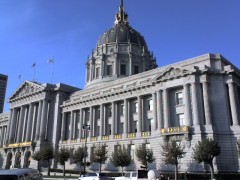
SF Civic Center on November 5 - Courtesy Chris Burwell
Yes, many of the lights are candles, but count (on) the devices.
In closing, I conclude (and beseech), for the Web 2.0 Summit 2008:
WEB MEETS POLITICS: Be a device-driven world — Not a divisive world!
Suffice it to say these are among the busiest two weeks of my life — and in many ways, the best. I’m working hard on the California No On Prop 8 Web Strategy team. These days, I encounter stories of unbelievable courage and strength as an everyday matter of course. People are working in constant overtime to get the stories out. I work with a great diversity of beautiful people crammed together in a noisy space, every one of us working without pause, very hard. And my bride Leanne worked heroically today in the middle of a way-too-busy day to get out a post about the seemingly amazing superhero powers endowed to us, by virtue of our recent wedding, by the proponents of Prop 8. Then I come home to a story of how my parents returned from a trip to see No On Prop 8 signs — in Vacaville! — and are eager to let me know.
And then, from people I don’t even know, amazing stories hit me every day during this campaign — some are shocking and some are intensely saddening, but most inspire me — and some truly warm my heart. I have been privileged to share some deeply personal stories.
Last Saturday, Tweeter @arwilson sent the following in response to a Twitter-based request from @NoOnProp8 to share what people were doing to defeat the proposition:
What followed was a private conversation by direct message, and soon an in-depth email exchange. He very generously shared his story, and gave me permission to blog about it — so I quote him, Anthony Wilson — below. Tony called it an honor to share his story in case it could help someone somewhere.
We all could be Tony. Honest and brave are the people who challenge themselves beyond prejudice. Far from always successful, in my best days, I aspire to this. Thank you Tony for shedding light on your journey through — and past — this particular fear and prejudice. I ask anyone reading to do an inventory in honor of Tony’s sharing: Is there a bit of his story that resonates with you?
My mentor’s name was Del. When I was about 16, he and his wife took me under their wing. Through them I met lots of interesting people who were so generous to me and encouraged me to be my own person. I was very eccentric and was called a fag more than once. I couldn’t afford trendy clothes, so I “borrowed” old clothes from the drama department. Today I would have been called a cool Rockabilly kid, but at the time I was considered a freak, so I took the easy route and gave it as good as I got it. Shit rolls downhill, and I lashed out at anybody who seemed more vulnerable than me. Del was doing my makeup before a play (the irony was lost on me at the time) and I had mentioned something about “dumb fags.” He didn’t judge or condemn me, but he just asked me why I had such a problem with them. He mentioned that a lot of my friends that I had met through his wife and him were gay and that I liked them. He kept asking “why?” and I didn’t have an explanation. I then realized that my response to people treating me poorly because I insisted on being myself was to harass others who were trying to be themselves. I was helping out the wrong people. It was OK that I knew gay people, and I should be allowed to do so. I guess I thought that people would think I was gay if I had gay friends. I soon realized that I didn’t care what people thought. My parents had never condemned anybody, so I really had no excuse.
Del was a closeted gay man and fell victim to the first wave of “gay cancer” in the 80s. Even after I realized what was going on, his wife was in denial. After suffering massive medical costs and the condemnation of his family, he passed away. This had a profound affect on me, and I realized that homophobia was partly responsible for his death. If he could have lived the way he wanted, things might have worked out differently. Homophobia is responsible for so many of the world’s problems if you think about it. How many wars, how many violent crimes, how many people are denied their right to happiness by people who have some weird agenda. This epiphany taught me the true meaning of homophobia – as we all have seen in the last few years, the more you condemn it, the better the chances that you are doing it.
I can’t tell you how liberating it is to not give a shit what people do with their lives. It’s none of my business. Well, it was none of my business, but I want to do what I can to help anybody who needs it. I have lost friends to AIDS, I have seen friends denied rights because they were not legally recognized as partners; when a friend’s
partner was in a coma dying in the hospital, his partner’s parents would not let him visit. My wife and I have closeted and openly gay members of our family – I have gay friends who have been with their partners longer than I have been with my wife. They’re here and they’re queer and I got used to it! We live in Orange County, so it’s not the most open-minded place, but our daughters have been raised to understand that homosexuality is a non-issue. As a junior high teacher, I see kids who were like me, and I remember how Del approached it. Because of him, I am who I am today, and I want others to have that same choice.


 Moya Watson