Confessions of the Neither Cool Nor Corporate: Treo to Tour

Inwardly, my heart sank when I read the recent SFGate discourse on the polarization between iPhone and BlackBerry users and what it says about you (in a nutshell, I read it as Cool vs. Corporate ), because I knew my old Treo had broken for the last time and I was about to become an accidental and perchance reluctant early adopter of my first “cutting-edge” hardware device since the Sony Walkman — namely, the BlackBerry Tour. Thusly I heaved a big sigh and released my exclusive grip on the “neither/nor” don’t-label-me Treo world, and Became Corporate.

I had been happy with my old trusty Treo, not finding itself anywhere on the Cool to Corporate spectrum, but I had dropped it one too many times (making it a bit untrusty after all), and though I of course tried to keep using it, the shattered glass of the touchscreen posed the danger of lacerating my face whenever I answered the phone.  Plus, it stopped working, there’s that.

My Last Treo

My Last Treo

After a brief odyssey through a number of refurbished Treos, each mysteriously breaking in some other essential way, my enormously patient gadget-queen wife arranged to upgrade me to a BlackBerry Tour.  It arrived to me *the day of its release* — and she even heroically fought through apparently known BlackBerry/Mac issues and synched it for me while I was bathing and reading to our daughter that night.  And I promptly began my odyssey.

For all my online complaining about the difficulty in shifting smartphone paradigms — going from something so familiar and ubiquitously used to the “who moved my cheese” experience of misplaced keys is akin to the electric cool-aid acid test on unwitting lab rats — I actually did pretty well just playing around without (of course) even cracking the handy Getting Started guide (which I did AFTER I switched my BlackBerry off — at least I think I switched it off — that is, I’m not sure why I have to switch it off coming from the land of the nearly-always-on, insta-response Treo).

My New BlackBerry

My New BlackBerry

After trying to use the device like a Treo — which meant using a sub-standard mobile Web browser to launch minimal mobile Web applications in the place of all those Cool and/or Corporate device-native cutting-edge applictions such as bubble pop or whatever (does anybody even write applications for the Treo – anymore?) with a nevertheless comprehensible keyboard and near instant response in the applications (I had lived in m.facebook.com and m.twitter.com) — I finally was assimilated and downloaded the respective device-proper applications such as Facebook for the BlackBerry, ÜberTwitter, and Gmail for the BlackBerry.  I even pined unsuccessfully for blip.fm for the BlackBerry and learned I was not alone.  I learned to swim in the floaty interface as best I could, and I tweeted with my geo-location.  I even stopped — momentarily — trying to touch the touchscreen to get it to do things and let go of “Liking” on Facebook. And lapsed briefly into brickbuster (or whatever it is).

So I should hardly rant, and I hate to rant, but I’m going to rant.  After two weeks now, these things still drive me to absolutely NUTS:

  • Where ARE my text messages anyway? On the Treo, It was simplicity itself — it merited a special key, and it was simply SMS — simply threaded, simply reply-able, simply alerting and lighting up the device with the incoming messages themselves.  Not so on the BlackBerry, apparently.  If I can even tell apart the multiple BlackBerry messaging options.
  • And please by the way don’t make me register YET ANOTHER email address!
  • Somehow, at least by default, the nature of “alerting” on the BlackBerry levels text and email messages in the same playing field — and this is not what I want! (Think of all my BlackBerry friends I pestered the first few days, freaked out that my phone was ALWAYS vibrating! “WHY, why does it do that?”)
  • I can’t use trackball as insertion cursor effectively.  Can anyone? The trackball motion also skips and messes me up in brickbuster!
  • Who Moved My Keys!? Especially the questionmark and period!
  • Most disturbingly, why do my wrists hurt?
223K and still ticking

223K and still ticking

I’ll probably become second-nature with this strange new device soon and maybe I’ll even start to feel like it makes me seem Obamalike instead of corporate and conservative.  Maybe I’ll even feel like it’s highly featured and grow to wonder how I ever got along without it.  Not yet.

The first morning after, I awoke from dreams about trying to use the dang device.  I was trying to learn to use the trackball *just right* (ahem) to roll the umlauts over the “U” in UberTwitter).  Plus, my hand hurt.

I guess now a new car to replace my 223K-mile car can’t be too far.  Please just don’t let it be a corporate car.  Unless it’s also a fuel-efficient yet powerful RACECAR!

The Curious and Somewhat Awkward Case of Social Networking Inside the Enterprise

Ross Mayfield

Ross Mayfield - Socialtext

Thanks to a great internal team at my company called SAP Research, we’ve been treated to a series of visits at SAP in Palo Alto from prominent Silicon Valley social media figures. Last week, we saw Ross Mayfield (Chairman, President & Co-founder of Socialtext — “The first wiki company and leading provider of Enterprise 2.0 solutions”) talk about “Putting Web 2.0 to Work; Social Software in the Enterprise.”

If you haven’t already noticed, “the old notion of the workplace is changing,” says Mayfield.

Employees aren’t punching time clocks anymore. Today, more employees are spending more time working remotely, and many of today’s companies have employees working together on the same projects from different corners of the globe in separate time zones. This creates changes to the way people work. …
Ultimately, the more effortlessly employees can communicate, collaborate and share new insights with one another, the faster an organization can respond to changing customer expectations and business conditions.

This “new world of the workplace” has ramifications that reach far beyond just how you gossip with your colleagues. For example, according to some, instant-messaging-like activity streams such as what we see in microblogs like Twitter have the potential to disrupt or even replace what we know of today as the supply chain. “Web 2.0 technologies re-shape the way Enterprises do business,” underscores Mayfield, “including how their employees communicate and collaborate and how these businesses interact with their partners, suppliers and customers. ” My Twitter-stream tells me this is also a point espoused by Twitterer Steve Gillmor –  in his http://www.techcrunchit.com/ blog.

While Mayfield makes a strong, easy-to-understand case for how transformative these technologies are to the Enterprise, he also expresses understanding for the common issue of Enterprise-internal social media adoption. Not only is it tricky to “keep your work identity separate from your personal identity,” it also can be seen as hard to open up YET ANOTHER channel when you’re already overloaded with your email inbox.

One key to this — especially internally — is to “use your own social network as the filter.” You may not have called it “social networking” before, but you have already been working this way since your first day on the job — and here I don’t just refer to engineer-hackers who have been wielding the backchannel for a number of years already through IRC and other chat functionality. “The way people solve exceptions is by turning to their internal network inside their company,” Mayfield continues. In some ways, the new media are merely underscoring the importance of the old notions such as influence and popularity. While that’s hardly news, never before has it been as easy to interact with — and add to — your social network, despite company, physical, and even geo-political boundaries.

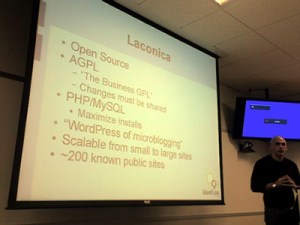
Evan Prodromou - Laconica, Identi.ca

Evan Prodromou - Laconica, Identi.ca

As a case in point, in the same SAP Research series, a couple weeks ago, we got to watch another prominent social media figure, Evan Prodromou (the developer and entrepreneur behind microblogging site Identi.ca and its software foundation, Laconica) also hold forth about the point of this newish phenomenon of “Enterprise microblogging.” Prodromou’s bottom line seems to be that while microblogging is here to stay, Twitter may be a passing fancy, and the key is in opening up the infrastructure and providing the foundational tools. Drawing an analogy between how Apache was instrumental in pushing the Web forward, his open source Identi.ca / Laconica platform paints a future of “a different microblog universe” in which “the future is a federated microblogging world” involving “thousands to millions of microblogging services, all interconnected by an open protocol.” Calling Laconica “the WordPress of microblogging,” Prodromou says he hopes it will play the same kind of role “that Sendmail and Apache have played in their respective digital media.”

But Prodromou openly pondered whether the notions of influence, so key to external social networks, would be as relevant inside an Enterprise. While who’s “important” and who’s an influencer inside of your company may hardly be who you’re having cocktails with on Saturday night, who you “follow” and connect with via your internal social networks is going to be a growing trend to watch. Is everyone going to automatically be following everyone, or do you follow the “right” people? Are you yourself considered “an influencer” at your company?

One bottom-line of clarity for microblogging in the Enterprise upon which people agree is the ease of adoption. The biggest impediment to the use of social media (not just inside the Enterprise) is to ramp up users to the software. “Getting users to use social media is very difficult,” says Prodromou, but “microblogging makes this MUCH easier. If you can get people to use short status updates, you get a lot of the benefits of the Enterprise 2.0 idea without a lot of pain from end-users.” Concepts of networking, of groups, of following and followers and of influence – they’re all there as much as on a more intensive application such as Facebook or Cubetree, but all you need to do is write 140 characters every now and then about what you’re doing. “The training time will be about 10-15 minutes” to use microblogging.

In the end, whether online or offline, internally or externally, micro- or macro-blogging, it’s the “combination of people and tools that make up how this is going to work.”  The people — YOU — are the key to the transformation of any Enterprise.

Partially abridged from an Enterprise-internal blog post.

Sick

I’ve been attacked by the norovirus — worst I’ve ever had it — but news from colleagues makes me even more sick today.

I’m also thinking of Leanne’s Harriet — a true hero of the ages — and wishing both of you well.

Lastly, today is the anniversary of Robert Frankl’s death. We still love you, Robert.

That’s what it’s like to have a stomach tied up in knots …

Best thoughts to all during this truly difficult time.