Ships and Service in the Great White North

Yes, friends, there is still ice – and cell service – in the great white north. Having nothing with which to previously compare it, I’m not sure if it’s a whole lot, but we did sail by a real-live glacier or two on a ten-day cruise up in the northerly direction recently. I still feel a little wiggly and think I’m not done getting my land-legs back.

For better or worse, we spanned a large amount of water to get to Alaska and whatever ice it has left (at least in its southern Canada-like tail) in a giant ship. And that water was, we were to learn, often rougher than ever.

Once we surmounted that outside passage, we happily turned to the inside and followed the falsely named Lynn Canal, tracing the passages (and apparently sailing over some carcasses) of the old ships of would-be goldseekers. The farthest we pushed north was Skagway, AK.

Since the gold is long gone, I don’t believe any of these towns would exist anymore were it not for the visits of seven cruise ships a day throughout half the year, though we were interested to note that in all of our ports of call, cell service was excellent. Tracy Arm Fjord aside.
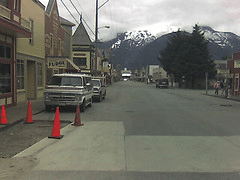
I’ll never forget that icy canyon, freezing at 6am, not getting so close to receding glaciers, seeing the four tiny white dots of goats clinging to the canyon walls, all the while lumbering away in a giant cruise ship that somehow seemed false. I almost hope we stole away before anybody noticed, but the receding glaciers probably know.

Another fine example of service in the great white north – Alaska blogging. Check out this one for just one fine example: http://alaskatheviewfromuphere.blogspot.com/

The views are often achingly gorgeous. I definitely want to go further next time.

Often, though, one of the best things about going away –

is coming home.
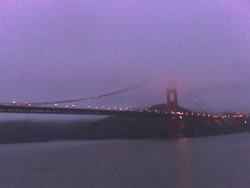
ps: But did I mention Canada? We had a lovely stay in Victoria. Canada feels like home.
Sustainability and the Long Tail

It strikes me that the “long tail,” the economic model popularized by Chris Anderson, either IS or IS NOT about extinction. With the long tail, says Wikipedia, “Businesses with distribution power can sell a greater volume of items at small volumes than of popular items at large volumes.” What this means to me is that I can find and buy whatever I want, usually on the Internet.

It’s well known around our parts that legions of bookstores have been forced to close directly or indirectly because of internet competition. No doubt this was a factor in brick-and-mortar Tower Records’ demise as well. This greatly affects the quality of life in our communities. Don’t get me wrong: it’s nice to have the choice of what I want to buy – and to be able to buy exactly what I want.

Take lightbulbs. I have a lamp that in rather ominous terms calls specifically for “Type B” lamps: “RISK OF FIRE. USE ONLY TYPE B LAMPS.” Now – I don’t even know what Type B lightbulbs are. And did I find them when I walked to the local hardware store? Nope. Did I buy the dangerous, threatening Type A lightbulbs instead? Yep. Could I have found Type B lightbulbs on the long-tail of the internet? Most certainly. Given the choice, here I am willfully risking fire over the potential closure of local hardware stores. Provided the dangerous B bulbs don’t burn our house down, this means I choose sustainability.

For local, sustainable food, the long tail might mean a species, one way or another. Oddly enough, as Barbara Kingsolver points out in her latest great book Animal, Vegetable, Miracle (which of course mildly ironically has a corresponding Web site), widely consuming and hence escalating demand for rare vegetable foods means they are more likely to survive as species – for instance, special heirloom vegetables such as tomatoes or potatoes. Not so for wild animals! For example, for our threatened pacific wild salmon. More consumption means more risk of extintion (though the salmon farmers would have you believe otherwise). It could be that long-tail models are both helping and hurting when it comes to sustainability.

Speaking of salmon, according to the Monterey Bay Aquarium’s excellent seafood guides, the one place they still run abundantly free and wild is up in Alaska. And in fact I’ll be out for the next two weeks on the Dawn Princess as it leaves its long-tail wake in the oceans up towards Alaska. While I don’t expect to be twittering or flickring (well, probably flickring) nearly as much, you CAN catch a glimpse of everywhere we go with the bridge cam. I’m sure you’ll be on the edge of your seat!

We’ll try to leave a few salmon left over in the sea for everyone.

My Epicenter and I Feel Fine

You know where I am. You can know at nearly all times. I am epicentered here. And I feel fine.

The Internet is starting to focus on location in combination with feeling, and you can now often know not only where someone is, but how they are feeling. For instance, I can get on the Internet and tell the USGS where I was on Friday morning at 4:42am and exactly how much of the 4.2 earthquake I felt.

I can also watch as people wander around the city, talking about what they see and how they feel. This phenomenon is called bio mapping. Says Brady Forrest on the O’Reilly Radar, “The Bio Mapping project sponsors people to walk around an area with a GPS and a Galvanic Skin Response sensor and logger. The emotional responses of the participants are then mapped.” Just about the closest you get to my house in San Francisco (PDF), you see a “pretty active area with lots of bars.”

Though not always mapped to precise physical location (but often so), on a recent roadtrip, I was able to Twitter about exactly where I was and what I was doing – as if the GPS in the car were not enough to track my whereabouts at all times. The most poignant lingering memory this represents for me is that that vacation is over. (Fear not – another begins next week!). You can even Twitter about earthquakes – though the chatter was decidedly light for Friday’s event. And if Twitter’s interface doesn’t cut it (and it doesn’t, to me), I can always go Jaiku.

On http://www.wefeelfine.org, I can get an interesting feel for what people feel and where they feel it. Someone in Leipzig, for example, apparently feels detached. Someone in Florida feels sandy. I love to click around the happy dots and squares on this site.

One of the coolest recent things I saw along the lines of collective location was a demo of Microsoft Photosynth (link courtesy, as many cool things are, of Michael Biermann at SAP). Towards the middle of this video, you can see a demo of what happens when you take the whole community of geo-informed photos of Notre Dame and patch them together. An awesome moment. Says the demoer:

We can do things with this social environment, taking data from the entire collective memory visually of what the earth looks like, and link all of that together and make something emergent that’s greater than the sum of the parts.

“A ‘long tail’ model of the entire Earth,” they say.

I tend to stay awake after earthquakes. It’s a throw-back to being in the middle of the large earthquake in 1989. I tend to go back in my mind and remember where I was then. But the Internet was not such a self-emotive, geo-located community of shared feeling back then, so I have no collectively preserved archive as such. What I did find was this. Two blocks from where I was then:

Female dispatcher: Can I ask you something?

CEH: Yea.

Female Dispatcher: Did you have something going to Sixth and, what is it, Townsend?

CEH: Sixth and Townsend?

Female Dispatcher: We ordered it a little while ago. Just wondering if you had one.

CEH: I don’t see Sixth and Townsend.

Female Dispatcher: Okay, hold on. (keying police radio transmitter) Unit requesting Sixth and Townsend 408? an ambulance. Boy 103, did you have a Sixth and Townsend request?

Boy 103: 10-4. That’s best way to get in there is Sixth and Townsend, and the Fire Department and police will direct them to where the injured parties are… (Boy 103 is then covered by an unidentified officer who says) They had requested two ambulances.

Female Dispatcher: What’s the level of injury, because they have their lists of priorities up here too. They’re going crazy.

Unidentified Police Unit: It’s going crazy out here.

Female Dispatcher: Yea, what kind of injury? (no answer in few second so she says to CEH dispatcher on phone) Okay, well, Sixth and Townsend, you know, put it on there definitely. They had requested two ambulances.

CEH: Uh-huh

Female Dispatcher: Okay, so, I don’t know. Try…try middle priority.

CEH: Sixth and Townsend, Code 2. All right.

I walked right by the incident to which they refer. It was super scary.

The Internet at its best could really be able to help our communities during times of disaster. While I don’t look forward to those, I look forward to that community, hopefully, being there for us – wherever we are and however we feel.