Telling Three: “Passion Unites”

San Francisco CA 2004 (#1)

San Francisco CA 2004 (#1)

Today is a bright day in the Bay Area and as we emerge, gradually, into the sun my “loss” mood — sort of — disperses. I got a great email this morning from an old colleague that also helped me feel bright, and I wanted to share it.

Knowing of my involvement in the No On Prop 8 campaign, she, like many of my friends, wanted to personally contact me after watching the deeply moving Courgage Campaign video, Fidelity.  In addition to Fidelity, there’s another parallel initiative happening right now that puts a face on the current affairs of marriage equality: Tell3 — the “pledge to Tell3 people what it’s like for you or your loved ones to be LGBT.” The exchange with my colleague made me think of Tell3.

Particularly at work, coming out — as the only “whatever you are in the room” — can be a scary business. In my job, I work day-to-day with people from all around the world, including places where you could be jailed, or worse, for being gay. I remember that day almost exactly five years ago, when Leanne and I were married at City Hall, and how bubbly and yet awkward I felt when I came back to work after the weekend. I was practically tumbling all over the place that Monday, not able to contain anything about my weekend yet finding myself within the curious confines of a conference room with my team, every single one of whom spoke a different native language than I. Many teammates were surprised when I told them I was married over the weekend. Most were, at a minimum, highly confused or even thought I must have been joking. One told me that I was “brave” — which to this day I still wonder about. How was I brave? I could not say that any one of them was less than supportive, but the moments were not easy.

But every once in awhile I’m reminded of why the clumsy business of just being who I am — this “coming out” — continues to be the brightest, most worthwhile endeavor in my life. That’s how I felt this morning when I read Darlene’s mail:

Michael and I both cried (no laughing!) when we saw the slideshow, and then we signed it (of course) and forwarded it to friends and family members. Oddly enough we’d received it from our old Realtor in Dallas that we hadn’t spoken to in years. What’s so inspiring about that is how passion unites people….even from afar…..and even from those that are not directly involved. If only the world functioned like that for everything we do!

Did I mention that I have THE BESTEST Hubby in the whole world? I thought about it a lot. and I truly cannot imagine how it would feel if state could revoke our marriage. Putting all emotion aside, there’s just no logical/legal justification for the state to reverse/dissolve marriages (of any kind). IMHO, it appears that it’s a purely subjective stance that’s been taken and I don’t see how it could be reversed. Taking a step backward is just too risky for California (known to be trailblazers) and I don’t believe it will happen. My $.02.

“If only the world functioned like that” indeed. But when you do this — when you reach out and come out and share about WHATEVER it is — it does. And that makes all the difference under the sun… Thank you, Darlene, and everyone else who makes it your business to reach out with your stories.
Loss

Oh this rain — the kind so constant that the sky and the ocean seem to become indistinguishable. I crave it; I want to be in it.  Dry under my roof tonight, I read this — Pro-gay-marriage movement looks to ‘Obamify’ (SFGate) — and what I feel? Is loss.

It’s not specifically the loss of the election (which I imagine will retain its special hole in my heart well beyond the time when equality isn’t even an issue anymore). I feel no loss about the purpose of the report, which talks about all the great energy going into galvanizing grassroots and online activism. It’s truly both the seeds and the fruition of the Internet united: Not only can everyone tell their story, but they need to — and it changes everything. The world is our neighbor — now more than ever.

Nor do I just feel loss about the massive support we built online during the campaign going unrecognized in passages like this:

It would involve pairing new media technology with old-fashioned, door-to-door outreach – two tactics that were not used well in the unsuccessful opposition to Proposition 8 in November, according to a report by Marriage Equality USA, an Oakland-based organization that supports gay marriage.

… as similarly played out countless other articles like this and the endless comments threads they have spawned since the election.

In fact it’s not totally clear to me, the source of this loss, but here it is again:

Adina Levin, a Palo Alto software company co-founder and gay marriage supporter who is not gay, recalled a friend telling her that Prop. 8 supporters were holding signs on a corner in his San Carlos neighborhood. When Levin asked the campaign if she could use the micro-blogging service Twitter to quickly gather a counterprotest, No on 8 organizers said no, because it might tip off the opposition to their movements.

I don’t know who Levin talked to in the campaign, but connecting people online about protests is one of the major things we did on Twitter and in other online channels particularly in the days escalating up to the election. We didn’t do it out of a concerted tactic, we didn’t plan it, we didn’t strategize it — we simply listened in to the hundred-plus thousands of regular people, people not unlike you as you read this, who reached out and shared their stories via online channels. We did mobilize, we connected, we supported — not because it gave us a good reputation or a good story — but because there was the need.  And it’s not just no longer serving this essential purpose that I count as a quite personal loss.

The people I knew on the campaign dedicated themselves day and night, but afterwards went back to their originating, excellent organizations — far from the failed campaign — and yet I continue to exist in this crazy post-election nowhereland vacuum.  Articles like this remind me I feel strongly about not betraying the actual No On Prop 8 online community, which did and continues to thrive, because these people were literally unsung heroes.

As I sit here in the dark and try to put it all together, the rain pounds on the roof and my head hurts. My wife says I’m just hurting myself.  A pal from the campaign told me I just needed to let go.  I do — but I struggle with losing hope. And I hope I always do.

Serving the @NoOnProp8 Twitter community

Real-life stories from @NoOnProp8

@NoOnProp8 on Twitter

@NoOnProp8 on Twitter

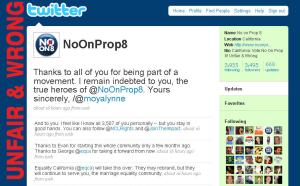
Last night I tweeted my final tweets as “@NoOnProp8.” I immediately got so much good feedback and appreciation that I nearly regretted giving the account away (note: the account is not going away — Equality California will carry it forward to serve the marriage equality community).

However, I’ve had to accept that there is no longer a “No On Prop 8 campaign,” so to speak, or at least that we need to move on to different campaigns.  I’m also excited to continue to be working with organizations involved towards embracing and better serving online communities.

In contemplating all that great feedback, I decided that the best way I can show my appreciation for having been a part of this community is to share what I learned with you.  So here we go — what follows are my real-life “best practices” for building and engaging a Twitter community — I was originally going to say “creating a Twitter community” — but since a lot of it is just paying attention to the community that exists already, “serving” seemed better.  All of this is thanks to you, the community itself — I only had to tune in and listen.  I cull the main things I heard down into four easy themes: Inform, Engage, Listen, and Measure.

Inform

The  initial mandate of this official campaign channel was to point to all communications from the campaign, from press releases to videos. As the campaign, and the community, evolved, we loosened  the mandate with official blessing to push “non-approved” messaging that served the community. We still were sensitive to stay within the overall messaging parameters — by not spreading attacks of any kind or propagating violence, and by trying to remain compassionate, for example.  Here are the sorts of things we did and learned in the “inform” category:

  • Point to every “official” press release
  • Point to every blog post from “official channels” — such as from Kate Kendell
  • Point to every new video on the campaign’s YouTube channel
  • We’d also occasionally post “un-approved” more casual messaging, reacting to what the community was asking for more of (for example, connecting people at rallies while they were happening)
  • Use http://tr.im or other link-shortener to trim URLs (tr.im was a suggestion from @krabigail in the community!)
  • Don’t be afraid of over-tweeting — tweet multiple times throughout the day if you want — but try not to deliver 5 tweets at the same time. People will let you know if it’s too much (but not if it’s too little).
  • Let people know that we are people and tweet what is happening at campaign headquarters, in the city, personally — and include real names/Twitter names when doing this  (thanks to the blogger community, @QueenofSpain and more, for these tips)

Engage

When I really listened to what people were tweeting, responding, and direct-messaging, the “engage” part was really easy.  It did take a lot of time, however. If I could, it was clear I could have spent nearly the entire day working with Twitter and its community (but I had plenty else to do).

  • Follow back every new follower — also, direct-message at that time (NOT automatically) with thanks and encouragement.  May also use this opportunity to send a pointer to a current story or latest action or other item of interest, to immediately invite the tweeter to engage.
  • Respond to every direct message; respond to @ replies where it makes sense — where it adds a suggestion that serves the whole or encourages somethign everyone can do. (I @ replied people less frequently than I dm’d). Put another way: keep what’s relevant for the public stream in the public stream — direct-message people when it’s a personal conversation.  This is a point that I notice many business Twitter accounts doing differently, so I’m willing to adjust based on feedback.
  • Requests for promotion:  We got a lot of people asking to promote their own blog posts — which I appreciated — but generally I avoided using our Twitter for individual promotion — including self-promotion. I tried to keep that to my own Twitter account. However, I did encourage people to publicly “@” NoOnProp8 when they had a post – that way, it would appear in the public timeline.
  • Again, use our real names or individual Twitter usernames when engaging personally.  I suppose this is a bit like “self-promotion” — but people let us know they wanted to know we were people, so I would occasionally remind people who I was.
  • Ask people specifically to retweet sparingly.  People in general did a LOT of retweeting just on their own, which was GREAT, but I only requested it if something was REALLY important or time-urgent.
  • We also — and this is key to helping your friends and colleagues say the word “Twitter” with a straight face — used Twitter successfully as a donation channel in the campaign.  If you “try this at home,”  make sure you can track which funds are coming in through Twitter by through a parameter identifying the donation link.
  • “Mini-campaigns” for engagement — ask a question, and use tags plus http://search.twitter.com for a great way to surface results to everyone, providing visibility for people as well. Thanks to @Pistachio for setting the example here. It goes like this:
    • During the campaign, we asked “What are you doing today to beat prop 8?” and told people to “tag” responses by adding “#beatprop8”
    • At http://search.twitter.com/, search for “beatprop8” — http://search.twitter.com/search?q=beatprop8
    • After responses start to come in, you can then click “feed for this query” or directly “twitter these results” — which will twitter a trimmed URL to the search results. This caught on really well.

    Provide a place to just BE — if people are venting, let them vent; support; connect

Listen

This one is really key. You can tell from all the other sections that we got a lot of good things to do out of just listening.  Examples:

  • I noticed a lot of replies to @NoOnProp8 about rallies, so I began distributing information about where and how to connect with people. It was well received, so I paid attention to growing it even more.
  • Lots of people wanted to know how to volunteer, so we were able to hook people up to their local field offices this way — and also to get signs, which was a very popular request.
  • We also heard about several new house parties this way, and were able to connect people to their closest event.
  • Conversely, when I initially followed back all new followers with an “@” reply, the community also let me know that they didn’t like it — and I stopped.
  • We also learned about everything from polling place problems to the site being down to donation server problems, etc via this channel.
  • We corrected some messages that had some inaccuracies this way too!  Quick attention to the community’s response saved us from spreading any mistakes further.
  • Twitter knows no geographical boundaries — but voting does.  Nevertheless, we were able to engage globally with online momentum that in the end had an affect beyond just California.

Measure

This is part of listening — actually, part of all phases.

  • Keep track of follower growth. Good to keep a trend. Falling off? Change something. Great growth? Continue doing more of same.
  • Keep track of what people are talking about and note trends, feeding these back to official messengers
  • When you tweet links, running them through a trimmer like http://tr.im first is good for two things — shortening, as well as letting you track hits to that URL.
  • Use, and reuse, http://search.twitter.com — to measure what people are saying about / to / retweeting about your twitter account.
  • Note trending topics on search.twitter.com — the term “Prop 8” was consistently within the top-ten topics towards the end of the campaign.

That’s what comes to my mind and what I was able to track throughout the intense weeks of campaigning before the election, and in the couple of months since.  We had much, much success with Twitter and it was a great experience getting to know all 3,500-plus, but I’m sure I missed opportunities too. Feel free to add to the thread if so — and if you have any additional suggestions or feedback about what else we could have done or done differently.  And thanks, again, to you — the real heroes of @NoOnProp8.