Facebook, Privacy, and Logan’s Run

Logan Look! The Crystal! (courtesy http://www.crazy4cinema.com/)

Logan Look! The Crystal! (courtesy http://www.crazy4cinema.com/)

Facebook has been rolling out its yet-another-“why hello there, new privacy” settings to you and to me in various alerts and yellow dialog boxes over the last week, providing me the chance to once again wonder whether I like this constant opportunity to reappraise what I share with whom and when.

As often occurs to me when I’m thinking of gardens and walls like these, I think of Logan’s Run. As the Old Man says:

You know, they’ve each got three names. Yes. The naming of cats is a difficult matter, It’s just not one of your holiday games; You may think at first that I am mad as a hatter, When I tell you that each cat’s got three different names. See, they got their ordinary name and then they got their fancy name. And that makes two names, doesn’t it? And now it’s got a third name. Can either of you two guess what that third name is? Come on! Above and beyond, there’s one name that’s left over, and this is the name you never will guess. The name that no human research can discover, but the cat itself knows, and never will confess.

(Abridged from The Naming of Cats by T.S. Eliot)

It’s true. Like everybody, I have many faces. The Moya Watson you read here is usually carefully — sometimes even thoughtfully — crafted. I guess you could say this is my “fancy name.” (Though if you look to my earlier writings, they’re a lot more internal-monologue — imported from the nascent days of Blogger.)

Whereas, the moyalynne on Twitter is probably my “ordinary name.” This is my every-day “I’d rather be skiing than going to work” or “My daughter just said the most amazing thing” or “I just spilled my coffee”-silverware — and it’s published, for everyone, to see. It’s easy. Just like that.

AND THEN there’s Facebook. The Moya Watson on Facebook — like many — opens up a bit more in moments and images of herself and her family (usually ironically finding more nurture for this openness within the walled gardens of this closed environment). But she does this with people she knows, whereas with Twitter, she gets to meet people she never before knew.

Well, it was a somewhat easy distinction. Facebook, in starting to poke holes in that T.S.-Eliot-like interface, is drawing into a bigger Web of confusion. And the more we can tweak more of exactly who sees what and where (if we can fathom the Privacy Settings UI), the more the “Moya Watson of Facebook” finds she becomes an enigma.

It’s constantly strange to me when the freedom to just be who you are increases exponentially with more layers of protection. While no “social network” yet exists for the me inside my head, the name only I know and shall never confess, if it escaped it would probably — and then in that act itself — resemble little of me anyway.

At the present, I simply close those yellow alert boxes and find it’s too much worry trying to remain consistent and definitely too alienating for my psyche to have “the ability to control who sees each individual piece of content you create or upload.”  I’m finding I worry less and less about when all these people converge, and simply just exist. Maybe even (gasp) not post.  It’s the  “Look at your palm! The Crystal! It’s clear!” moment.

Logan, look! Look at your palm. The crystal. It’s clear … We’re free! It must be

Sanctuary!

Outside?

Exposed?

And yet, I post.

From Web 2.0 to World Wide EveryWhere

Thoughts on Sir Tim Berners-Lee, mobility and beyond at the Web 2.0 Summit 2009

Tim Berners-Lee at the Web 2.0 Summit - "We didn't call it World-Wide Web for nothing"

Tim Berners-Lee at the Web 2.0 Summit - "We didn't call it 'World-Wide' Web for nothing"

London schoolboy Tim Berners-Lee was just 14 when two computers talked to each other for the very first time 40 years ago via ARPANET, the predecessor to the Internet. It’s safe to say this turned out to be a bigger deal than anyone knew at the time (except maybe young Tim).

When he first conceived of the World Wide Web 20 years later (in 1989), Berners-Lee knew it had to be a fully open, public-domain platform. As he explained in conversation with Tim O’Reilly at the Web 2.0 Summit last week in San Francisco, “otherwise it would not have worked.” The system had to be really flexible, without proprietary formats and constraints, “a very creative read-write space, like a sandbox — a group collaborative thing,” to enable it to spread its usefulness across the whole world as he had conceived it.  “It had to be — we didn’t call it ‘World-Wide’ Web for nothing.”

One score, the change of a millennium, and the “versioning” of WWW to “Web 2.0” later, the Web is still trying to fulfill that promise. Berners-Lee acknowledges that Web platforms and blogs and wikis have approached that collaborative vision, but in an awesome perspective in his session which closed the conference, he reminded us that “only 20-25 percent of humanity actually uses the Web at all.”

While this begs the question how and whether the Web should extend to blanket the other three-quarters of the world, if you turn it around you can see that Web 2.0, now a kindergartner at five years old, is ready to be and continues to be itself disrupted through its reach — and hopefully by those who will need it the most.

The most recent, most potent disruptions are happening in the mobile, realtime, and local spaces and hence into the “everywheres and everyones” through the corners of the Earth. This year’s Summit did not disappoint along those lines both in terms of real news, cutting-edge developments, and a little bit of whimsey along the way.

On the local, realtime front, with a big kick in the pants by Twitter, the major search players are paying a lot of attention to the “everywhere, everyone, AND all at once” phenomenon (read Jeremiah Owyang’s good wrap from a business perspective on the related Google / Microsoft announcements). But one thing that was almost lost in the hype — almost buried in Marissa Mayer’s surprise announcement of  Google Social Search — is the local aspect.  Through the years we’ve witnessed the evolution of “finding things” from Browse (Yahoo) –> to Search (Google) –> to Share (Facebook) — and now we approach the next phase: all of the above, then add “Where” — and then EveryWhere.

Take a good look at the demo: first the Twitter-dare-I-say-Google-open-social-graph announcement has to do with bringing the particular GeoLocation of New Zealand closer to home, via your social circle.  But toward the end of the demo Google solidifies the geo/local aspect. Says Mayer, “You can see how analyzing these social networks can really improve the overall relevance, comprehensiveness, and quality of the results. And one of the biggest pockets we’ve seen where this can really enhance your search experience is on local information. Has one of your friends already seen that play? Have they been to that restaurant or have they been to that hotel?”

This is important because local may literally be “the last mile”  (thanks @donambridge…) of the three-quarters-of-the-rest-of-the-world for Web search, which starts to look more and more “old-school” the more people’s blogs are visited because of Twitter instead of because of Google.

Add the mobile component to realtime+local, and you have the game-changing combination.  Mobile is the “incremental driver of Internet user / usage growth” according to the always-excellent Morgan Stanley’s Mary Meeker session (PDF). “Next generation platforms (social networking + mobile) are driving unprecedented change in communications and commerce.”

Via mobile, the native intelligence of your (social) presence is flipping the “reaching beyond 25% of the world” question sideways — so that it’s not (just) about the fact that mobile reaches further, but mobile allows us to change the reach entirely.

Path Intelligence: Mapping the audience

Path Intelligence: Mapping the audience

Cell phone signals render humans as sensors (watch the amazing inventions on this panel), via multiple sensors in your iPhones, via where you are when, and via what you are sharing — explicitly or implicitly — about it when you are there.  From the “implicit crowdsourcing” that provides traffic and route information via maps and real-time feeds of Waze, to the entertaining audience statistics (and more) that Path Intelligence could glean by our (cell-phone-enabled) presence, to tagged, geocoded images that help you find invasive plants, to the incredible concept of “telemicroscopy for disease disease diagnosis” (CellScope), to the portal ultrasound gadget that GE’s Jeff Immelt brought with him to more… Needless to say, there is a huge wealth of innovation happening in the realtime mobile sphere.

Beyond mobile (since mobile infrastructure is not yet everywhere), we also saw some amazing satellite innovations at the Summit. Walter Scott of DigitalGlobe stopped by to give us a demo and some intriguing ideas about satellite imagery that we can now refresh two to three times a day. Perhaps Arthur C. Clarke did not even visualize this!

Aaron Koblin -- Visualizing Amsterdam SMS messages

Aaron Koblin -- Visualizing Amsterdam SMS messages

And speaking of visualization, some of the innovations coming out of the piles of data we get through all these mobile, real-time, world-wide sensors can be very, very beautiful.   Aaron Koblin, an artist specializing in data visualization who introduced  GAFFTA (Grey Area Foundation for the Arts) while at the Summit, has an amazing sandbox of visualizations.

So while only one in four people have ever touched the World Wide Web at all, both the Web and these people are going further than ever before. Tim Berners-Lee advises us to concentrate on the emergent trends of GeoLocation and a move from Web pages to mobile and apps, as well as the upcoming standard of HTML5. And one key takeaway from him is that we need to “make sure the Web is designed appropriately for other cultures as well.”

And while we’re at it, let’s make sure we’re listening to those other cultures and watching for the beauty in the great big pile of data, because “the other 75%” of everywhere has at least as big a chance of disrupting the Web as the Web has of disrupting it.

Wardrobe Wrap of the Web 2.0 Summit

Seconds away from writing a serious post on the Web 2.0 Summit last week in San Francisco, my head aches, I have a meeting in way less than an hour and a different project or three to manage, several other writing assignments, and I decide what’s important for the moment is to instead cover the wild whimsical wacky wardrobe world that was this year’s Web 2.0 Summit. Why do I feel compelled to do this? I have no idea. (If I don’t get that serious post up by the end of today, I’m probably abducted by aliens). And yet here I go.

Erin McKean's Tetris Dress

Erin McKean's Tetris Dress

First and foremost in any wardrobe wrap has to be a gigantic shout out to Wordnik’s smart and sassy CEO and co-founder Erin McKean who pitched a great high-order bit on the excellent Wordnik as well as their newly launched API for the English Language, ALL in her hand-made Tetris dress.

Then there’s John Battelle, who always looks particularly natty in his blue jeans, dangling this teaser of a surprise Google spot and entreating us to guess who it is based on the shoes alone. To which my handy Twitter-mate @UberShoeDiva (who does indeed have the UberShoes) responded thusly: “What is he *wearing* on his feet?? Those can’t be shoes. I hope not. I really hope those are just some edgy socks.”
(Those by the way are Sergey Brin’s Vibram Five Fingers )

And actually I’d have to say John Battelle came in tied for first place for best jeans this year – and you’ll just have to scroll through this really excellent session on Humans as Sensors to see why (catch Mobilizy’s Markus Tripp in his excellent jeans – or you can just get a hint of them here).

Brady and UberShoeDiva (AKA Jaimee Clements)

Brady and UberShoeDiva (AKA Jaimee Clements) cut it up

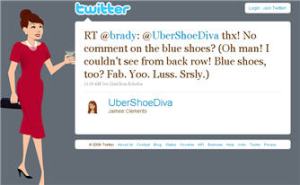
In the same video, know that no wardrobe wrap would ever be complete without a mention of @brady’s gorgeous purple shirt, green plaid pants, and blue shoes. Once again this goes not unnoticed by UberShoeDiva.

One out-of-character note for himself and for the summit was Mr. Tim O’Reilly — who was constantly seen sporting a SUIT, making you wonder if he or we all had been abducted by aliens.

Contrast this with the baggy-jeaned teens – at least the one who uses Blackle instead of Google (to save energy) – from the excellent What Do Teens Want? panel – and you get an idea of why I really love the Web 2.0 Summit among all other conferences.

"the Zappos guys"

"the Zappos guys"

And I simply cannot ever forget @lwaldal’s commentary of the “Zappos guys:”I’m sitting in the 3rd row and pretty sure that josh, liam, maynard and john onstage right now are all wearing the same shoes.” This observation even made Industry-Standard fame.

And finally, though what it has to do with wardrobe or what wardrobe has to do with anything I’m not sure, thanks to @lwaldal for pointing out “a chandelier for balloon boy” in this shot of how the Ballroom was decked out:

"A Chandelier for Balloon Boy"

"A Chandelier for Balloon Boy" - @lwaldal

The conference was jam-packed and a lot of fun but tiring, so this shot perked me up just when I needed it.

And now with that off my chest…