
Real-life stories from @NoOnProp8
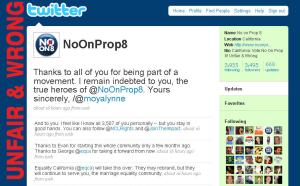
@NoOnProp8 on Twitter
Last night I tweeted my final tweets as “@NoOnProp8.” I immediately got so much good feedback and appreciation that I nearly regretted giving the account away (note: the account is not going away — Equality California will carry it forward to serve the marriage equality community).
However, I’ve had to accept that there is no longer a “No On Prop 8 campaign,” so to speak, or at least that we need to move on to different campaigns. I’m also excited to continue to be working with organizations involved towards embracing and better serving online communities.
In contemplating all that great feedback, I decided that the best way I can show my appreciation for having been a part of this community is to share what I learned with you. So here we go — what follows are my real-life “best practices” for building and engaging a Twitter community — I was originally going to say “creating a Twitter community” — but since a lot of it is just paying attention to the community that exists already, “serving” seemed better. All of this is thanks to you, the community itself — I only had to tune in and listen. I cull the main things I heard down into four easy themes: Inform, Engage, Listen, and Measure.
Inform
The initial mandate of this official campaign channel was to point to all communications from the campaign, from press releases to videos. As the campaign, and the community, evolved, we loosened the mandate with official blessing to push “non-approved” messaging that served the community. We still were sensitive to stay within the overall messaging parameters — by not spreading attacks of any kind or propagating violence, and by trying to remain compassionate, for example. Here are the sorts of things we did and learned in the “inform” category:
- Point to every “official” press release
- Point to every blog post from “official channels” — such as from Kate Kendell
- Point to every new video on the campaign’s YouTube channel
- We’d also occasionally post “un-approved” more casual messaging, reacting to what the community was asking for more of (for example, connecting people at rallies while they were happening)
- Use http://tr.im or other link-shortener to trim URLs (tr.im was a suggestion from @krabigail in the community!)
- Don’t be afraid of over-tweeting — tweet multiple times throughout the day if you want — but try not to deliver 5 tweets at the same time. People will let you know if it’s too much (but not if it’s too little).
- Let people know that we are people and tweet what is happening at campaign headquarters, in the city, personally — and include real names/Twitter names when doing this (thanks to the blogger community, @QueenofSpain and more, for these tips)
Engage
When I really listened to what people were tweeting, responding, and direct-messaging, the “engage” part was really easy. It did take a lot of time, however. If I could, it was clear I could have spent nearly the entire day working with Twitter and its community (but I had plenty else to do).
- Follow back every new follower — also, direct-message at that time (NOT automatically) with thanks and encouragement. May also use this opportunity to send a pointer to a current story or latest action or other item of interest, to immediately invite the tweeter to engage.
- Respond to every direct message; respond to @ replies where it makes sense — where it adds a suggestion that serves the whole or encourages somethign everyone can do. (I @ replied people less frequently than I dm’d). Put another way: keep what’s relevant for the public stream in the public stream — direct-message people when it’s a personal conversation. This is a point that I notice many business Twitter accounts doing differently, so I’m willing to adjust based on feedback.
- Requests for promotion: We got a lot of people asking to promote their own blog posts — which I appreciated — but generally I avoided using our Twitter for individual promotion — including self-promotion. I tried to keep that to my own Twitter account. However, I did encourage people to publicly “@” NoOnProp8 when they had a post – that way, it would appear in the public timeline.
- Again, use our real names or individual Twitter usernames when engaging personally. I suppose this is a bit like “self-promotion” — but people let us know they wanted to know we were people, so I would occasionally remind people who I was.
- Ask people specifically to retweet sparingly. People in general did a LOT of retweeting just on their own, which was GREAT, but I only requested it if something was REALLY important or time-urgent.
- We also — and this is key to helping your friends and colleagues say the word “Twitter” with a straight face — used Twitter successfully as a donation channel in the campaign. If you “try this at home,” make sure you can track which funds are coming in through Twitter by through a parameter identifying the donation link.
- “Mini-campaigns” for engagement — ask a question, and use tags plus http://search.twitter.com for a great way to surface results to everyone, providing visibility for people as well. Thanks to @Pistachio for setting the example here. It goes like this:
- During the campaign, we asked “What are you doing today to beat prop 8?” and told people to “tag” responses by adding “#beatprop8”
- At http://search.twitter.com/, search for “beatprop8” — http://search.twitter.com/search?q=beatprop8
- After responses start to come in, you can then click “feed for this query” or directly “twitter these results” — which will twitter a trimmed URL to the search results. This caught on really well.
Provide a place to just BE — if people are venting, let them vent; support; connect
Listen
This one is really key. You can tell from all the other sections that we got a lot of good things to do out of just listening. Examples:
- I noticed a lot of replies to @NoOnProp8 about rallies, so I began distributing information about where and how to connect with people. It was well received, so I paid attention to growing it even more.
- Lots of people wanted to know how to volunteer, so we were able to hook people up to their local field offices this way — and also to get signs, which was a very popular request.
- We also heard about several new house parties this way, and were able to connect people to their closest event.
- Conversely, when I initially followed back all new followers with an “@” reply, the community also let me know that they didn’t like it — and I stopped.
- We also learned about everything from polling place problems to the site being down to donation server problems, etc via this channel.
- We corrected some messages that had some inaccuracies this way too! Quick attention to the community’s response saved us from spreading any mistakes further.
- Twitter knows no geographical boundaries — but voting does. Nevertheless, we were able to engage globally with online momentum that in the end had an affect beyond just California.
Measure
This is part of listening — actually, part of all phases.
- Keep track of follower growth. Good to keep a trend. Falling off? Change something. Great growth? Continue doing more of same.
- Keep track of what people are talking about and note trends, feeding these back to official messengers
- When you tweet links, running them through a trimmer like http://tr.im first is good for two things — shortening, as well as letting you track hits to that URL.
- Use, and reuse, http://search.twitter.com — to measure what people are saying about / to / retweeting about your twitter account.
- Note trending topics on search.twitter.com — the term “Prop 8” was consistently within the top-ten topics towards the end of the campaign.
That’s what comes to my mind and what I was able to track throughout the intense weeks of campaigning before the election, and in the couple of months since. We had much, much success with Twitter and it was a great experience getting to know all 3,500-plus, but I’m sure I missed opportunities too. Feel free to add to the thread if so — and if you have any additional suggestions or feedback about what else we could have done or done differently. And thanks, again, to you — the real heroes of @NoOnProp8.


 Moya Watson