Aye, Paddy — She’s Not Quite Ready for the Enterprise, Captain

Alice in Wonderland

(not the only one to photograph their child with the ipad)

As I write this I’m sitting next to the iPad, ’tis true. Not using the iPad — sitting next to it.

I had no idea an iPad would be arriving at our house on Saturday, April 3, the very first day they became available (my wife needed it for her Web QA and usability business, so my first experiences with the iPad were blissfully unprepared and unanticipated).

While reports of the iMugging in the iMission near where I live were later corrected as a hoax (or at least, not quite as topical), with the first shipments of the promised devices hitting the town on Saturday, the whole city seemed nevertleless under its spell the entire weekend.

Though I have yet to overcome my primary association with iPad as introduced by MADtv, I did actually get to touch and poke and swipe and use it fresh out of the gate during the weekend. I should correct that slightly: my daughter used it the most, and I watched (and I am far from the only one standing by patiently with my kid using the iPad).  My snap judgment is that I generally concur with these first reviews that talk about how kids — or those thinking like kids — “get it” more immediately than adults. As my 5-year-old daughter exclaimed, “someone left a ginormous iPod TV on the stairs” – “getting it” instantly – and immediately all our other mobile devices are rendered instantly miniaturized, Alice-in-Wonderland “drink-me”-style.

In my (granted limited) hands-on exposure, my thoughts are that it’s BINGO for entertainment. We spent the most satisfying time watching (HTML5) videos – even already successful on (non-Flash) YouTube – as well as episodes seamlessly, instantly, and beautifully streamed via Netflix. News also stands to get a boost by this device: sites like the Times and ABC – both “printed” and video – render beautifully and perhaps, as my neighbor suggested, this will revitalize the ‘printed’ newspaper. For books however? Not an immediate replacement for the Kindlers out there – the backlit screen is still too harsh with which to spend that kind of novel time.

Leanne (faithfully testing applications as is her job) says many of the applications that are righteously hyped on the iPhone, notably including Twitter interfaces best known for being minimal, have not yet re-written their interfaces to capitalize on the extra screen real estate.  Other applications did fill up the whole screen, but awkwardly.

What I also found noticably odd from a physical perspective was being able to tune into the online – and hence tune out the offline (that means “the real world”) – seemingly more places inside the household than ever before, and more adeptly than with the more conspicuous mobile smartphones. Why did I really need to try to shop online for those shirts on Easter Sunday on the living room couch when I could have been talking with my family? Since the device is larger, though, it does lend itself to more “social viewing” within groups of people than does the smartphone.

In short, I felt it seemed great for pulling information and content – especially socially and severally; but for pushing it back — which for me is the important thing about the mobile generation of devices: not so good. No camera, no mobile carriers (yet), apparently some sensors, but no video. And the keyboard? The iPhone keyboard doesn’t work for me yet, so I hardly could have expected it from the iPad despite increased size, and I threw my hands up in defeat rather than type into all the fields required to finish my iShopping spree on the iCouch during iEaster.

Most profoundly for me at present, the “human as sensor” revolutionary element that we’re finding so key in worldwide civil rights demonstrations and current events seems apparently missing with this nevertheless-take-anywhere device. So, iPad, are you a mobile device or not? Are you a bit more like an interactive take-anywhere but still push-only TV?

Granted, perhaps my hands have yet to pull the Darwin in the right direction to adapt to the keyboard, but I’m a little surprised at folks who are already foreseeing giving up their laptops in favor of the iPad. Have they done a lot of typing on the ‘pad already?  I feel the major hurdle is still going to be digitization of text – perhaps the key will be in the evolution of usable speech-to-text.  Leanne says we just have to hook up the keyboards in the meantime — but I think it’s really a keyboardless and mouseless paradigm ahead.

For THAT enterprise-readiness — and we geeks remember when Scotty walks up to the computer in Star Trek IV and says “Computer?” — we’re not ready for prime time.  Maybe when my daughter is my age.

The Original iPad: MADtv ca. 2006

Ode to Marilyn Pratt: Honoring the Advocate on Ada Lovelace Day

At the top of the city with @moyalynne and @marilynpratt on TwitpicOf course I’ve known Marilyn Pratt, self-described in her Twitter bio as “SAP Community Advocate working to be a sustainable citizen of the world,” for many years, and yet we only just met this week. I’d never even so much as exchanged email with her until this year, but we’ve had a hearty online relationship. She’s been a big advocate for me – for my blog content (both personal and on the SAP Community Network) and on Twitter. If you’ve been active on the SAP Community Network she’s probably been an advocate for you too. She has been omnipresent and synonymous with online community at SAP, and so it was both stunning and unsurprising when I met her in person to find just how much more she is. Did you know, for example, her first computer language was Assembler, or that she directed IT for a kibbutz? Have you heard about her husband and five children, who are obviously as dedicated to her as she is to them? Did you know she came to SAP, in a roundabout way, as an escape from a truly (literally) toxic situation?

The second I found out Marilyn was visiting Palo Alto from her hometown New Jersey during Ada Lovelace Day, my schedule turned upside-down. She arranged for me to participate in an awesome interview with Marge Breya. She set aside precious time to meet me — out of so many on her schedule — and, most profoundly, she let me show her my home.

I was honored to be able to drive down the road with her, introduce my family to her, take her to the top of my city San Francisco, dine with her, get a chance to sit and share with her, and follow her in her (tireless, and often sleepless) work dedicated to advocating for others — indeed, to “amplifying the voice of the disenfranchised.” She would find spotlighting herself the least worthy cause of all, and it was only under great collective pressure that she finally cracked and allowed me to allow her to — although she would not say so herself — let her tell it the best.

Ergo — in honor of Ada Lovelace Day 2010, I dedicate this to Marilyn Pratt, a true technology heroine who honors us all and makes advocating for the community her (dare I say our) core business. Without further ado: Marilyn Pratt

BONUS VIDEO! Marilyn at work on Ada Lovelace Day in Palo Alto:

“Amplifying the voice of the disenfranchised doesn’t mean a protest voice — it just means making sure that people who might demur have more focused ability to be visible and make themselves heard.”

— Marilyn Pratt, SAP Community Advocate

Save Our Schools: March 4 Day of Action

Under a bright blue sky, I joined my daughter and her elementary school, Harvey Milk Civil Rights Academy, in a walkout today to protest the planned massive and catastrophic budget cuts to an already fairly impoverished city school district. Over the next few days we expect many of the people who work at her school to receive pink slips. District-wide, over 900 people expect to be notified that they will be laid off.

People are marching around the country today to bring attention to the crisis in educational funding of all kinds — but in our community, the kids said it best.

We rallied in the schoolyard before we marched through the neighborhood. I spoke to some of the teachers and staff, who expressed not so much a (very real) fear for their own jobs as much as pride, admiration, and support for the kids. “It’s not about the adults; it’s about the kids that are going to be affected in the long run… We’re losing good teachers… which means we’re losing our children, the future,” said Coach Glenn Castro.

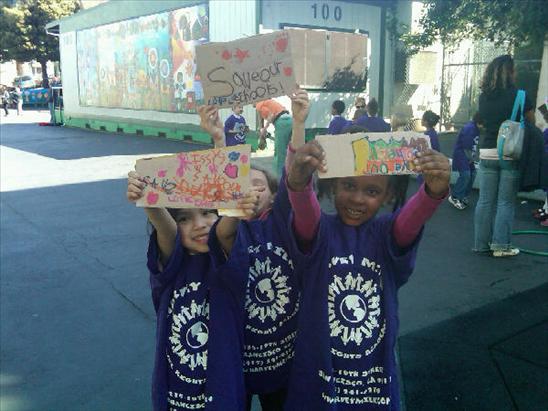
Save our Schools - Love, Lucy

Save our Schools – Love, Lucy

The kids had all made signs — my girl’s said “Save our schools; love, lucy.”  Others demanded to “Prioritize education” or begged “Please don’t take our teachers away.”Principal Christina Velasco banged the drum to the chorus of “Save our Schools” as we marched up Castro street, blocking traffic and getting a lot of cheers from the community. At Castro and Market Ms. Velasco led the group into a passionate sit-in:

“Today as you sit you’re sitting for your education — for your future. We need to let everyone know that it’s not ok that they’re cutting money and those cuts affect you.”

Some kids got up during the sit-in to address the crowd — and I can attest that there’s no passion quite like the passion of our community’s children. Andre said “Our teachers are our future and I don’t want to lose ANY of them!” People in the crowd were in tears as another student got up to talk about how he didn’t want to lose his teachers. “I don’t want to end up on the streets like other people,” he said.

These kids truly are our leaders. The truth they speak is pure and strong — and urgent. Are we listening?

Save Our Schools - Love, Your Future

Save Our Schools – Love, Your Future